

Garipa - Theriso,
West Crete
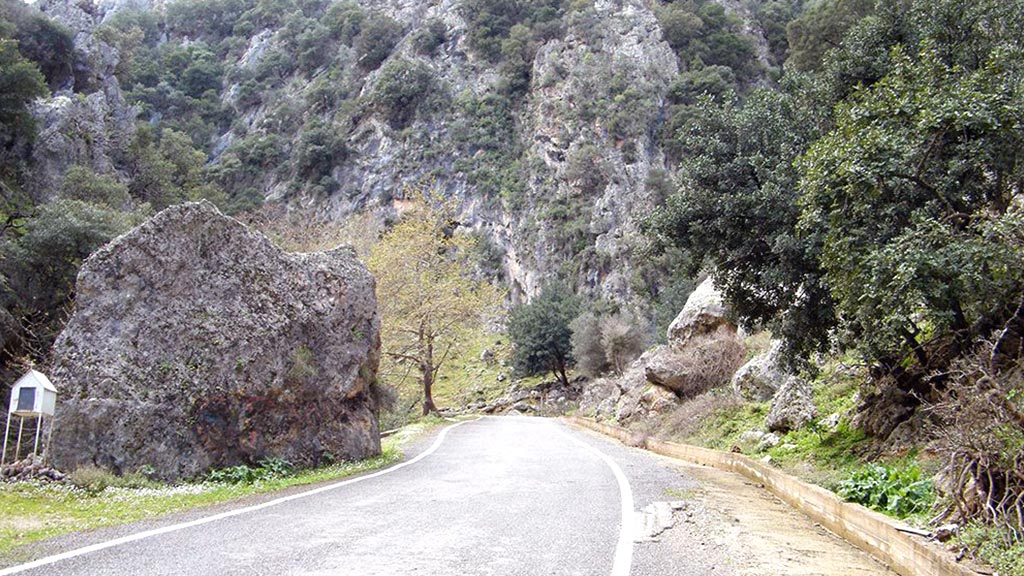
The journey from Garipa to Theriso is a 9.7-kilometer ascent that serves as a dramatic transition from the lowlands of Chania into the rugged "Lefka Ori" (White Mountains). This route is defined by the Theriso Gorge—a majestic, green-walled canyon that allows motorists to experience the raw scale of a Cretan gorge from the comfort of an asphalt road.
1. The Approach from Garipa
The route starts at the Garipa setting, a quiet district on the edge of Perivolia, just south of Chania. This initial stretch is a gentle lead-in through cultivated valleys filled with orange and lemon groves. The air is sweet with citrus blossoms in the spring, and the road is wide and easy, providing a smooth start to the mountain climb.
2. The Jaws of the Gorge
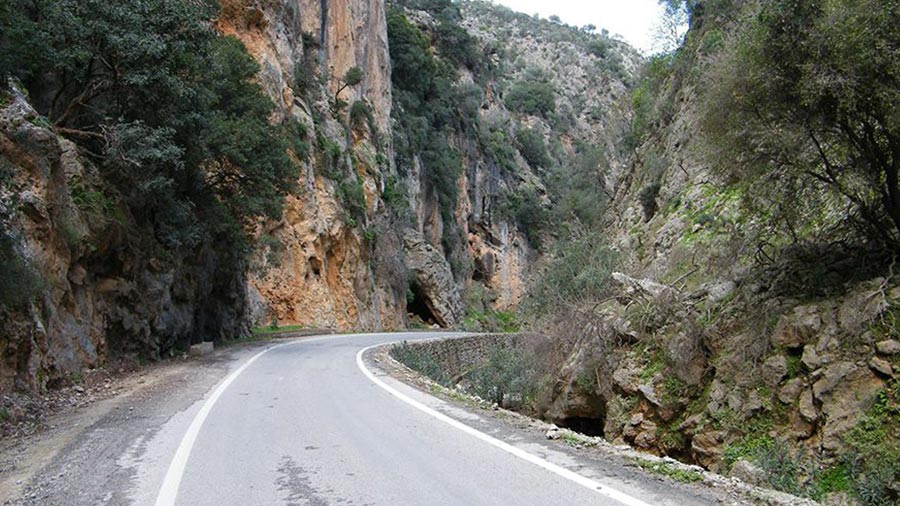
As you leave the orchards behind, the landscape narrows abruptly. For the next 6 kilometers, you are deep inside the Theriso Gorge (also known as the Eleftherios Venizelos Gorge). Unlike the dry, rocky canyons of the south, Theriso is remarkably lush. The road follows the bed of the Kladissos River, shadowed by towering plane trees, oleanders, and cypresses. The vertical limestone cliffs rise hundreds of meters on either side, often creating a natural canopy over the asphalt.
3. The Vertical Walls
Midway through the gorge, the canyon walls become incredibly steep and narrow, reaching widths as slim as 25 meters. This is the most scenic part of the drive, where the scale of the rock formations is truly humbling. Look up into the high caves and crevices; you will often see the "Kri-Kri" (Cretan wild goats) balancing on impossible ledges far above the road.
4. The Historical Arrival: Theriso Village
The route concludes as the gorge opens up into a high-altitude bowl where the village of Theriso sits at 580 meters. This isn't just a mountain village; it is a national landmark. This was the base of the 1905 Revolution led by Eleftherios Venizelos. The village today maintains a heroic atmosphere, with stone-built houses and traditional taverns clustered under massive, century-old plane trees.
Whispers of the Gorge: Local Secrets
Museum of National Resistance: Theriso's history as a rebel stronghold is preserved in the Museum of National Resistance. The exhibits detail the village's pivotal role in Cretan struggles, from the 1905 uprising to the resistance against Axis occupation in WWII. It is a must-visit for anyone wanting to understand the "Sfakian" spirit of the Chania mountains.
The Revolution Headquarters: Just a short walk away is the house that served as Venizelos’ headquarters during the 1905 uprising; it now stands as a dedicated historical museum.
Mountain Gastronomy: Theriso is famous among Chania locals for its meat. The taverns here specialize in "antikristo" (lamb cooked across from the fire) and fresh "staka" (local sheep’s milk cream).
Rider’s Notes
Road Width: Mostly two-lane, but becomes narrow inside the gorge. Be cautious of tourist trains and delivery trucks that can take up the center of the road in the tightest bends.
Surface: Good quality asphalt throughout. The road is generally clean, though autumn rains can bring small stones or leaves onto the surface.
Difficulty: This is a very easy and pleasant drive. The main challenge is the narrowness in the gorge, which requires you to keep an eye on oncoming traffic.
Caution: The gorge is a popular destination for hikers and rock climbers; always be prepared for people walking on the edge of the road, especially on weekends.
Info box
Surface: Asphalt
Road classes: B road
Terrains: Mountainous
Traffic: Almost none
Coordinates start (DD): 35.472707,23.987842
Coordinates end (DD): 35.405181,23.983924

Near by
POIs